The Attachment Lab
Participate in Research
Families who visit the lab make our research possible. Here is why it matters, and how taking part works.
Why participate in research?
The Attachment Lab is the first research lab in Egypt and the Arab world to use the gold standard of attachment research to study attachment. Hence, your participation in this research helps create a foundation for culturally sensitive attachment research.
Additionally, some Attachment Lab studies provide participants with benefits for participating. These may include vouchers, webinars, resources, or more!
- Vouchers
- Webinars
- Resources
- A small thank-you gift
How to take part
From finding a study to your visit to the lab, step by step.
- Step 1
Find a study & fill in the interest form
If you are eligible and would like to participate, fill in the interest form for that specific study.
New studies are also announced on the lab’s Instagram page.
See open studies on Instagram - Step 2
Wait for a phone call
A research team member will call you to arrange an appointment for your visit.
- Step 3
Make your way to the Attachment Lab
As a participant in an observational study, a free parking spot will be reserved for you in front of the Omar Mohsen gate, the gate closest to the Attachment Lab.
Upon entering the university, please make sure that you have either your alumni card (if you are an AUC affiliate) or your national ID.
Watch the directions to the lab
Follow the signs to the lab - Step 4
Your visit!
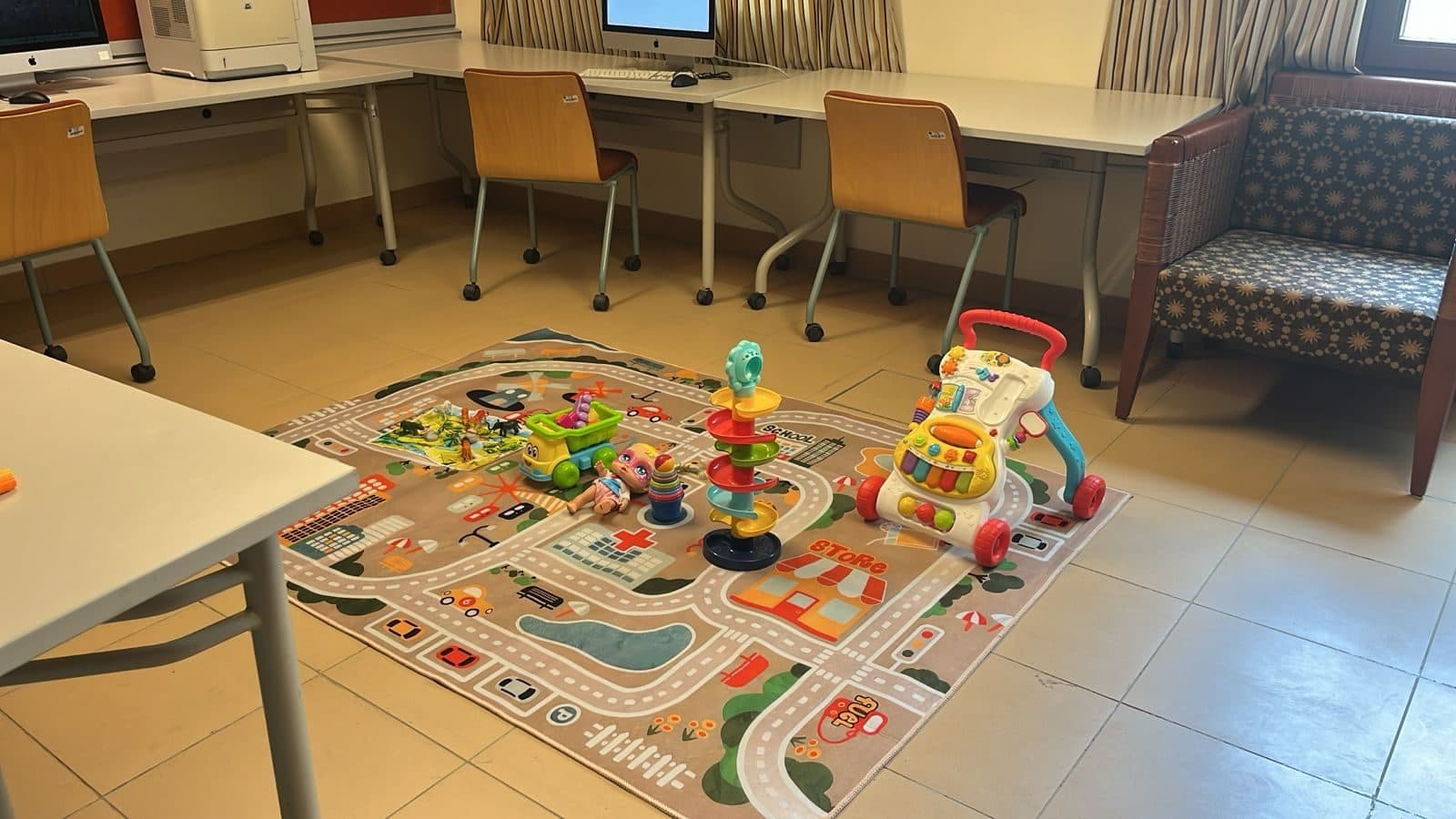
Once you arrive on campus, a research team member will pick you up from the gate and escort you to the Attachment Lab. The lab has three main rooms: an orientation room, an observation room and a playroom.

The orientation room 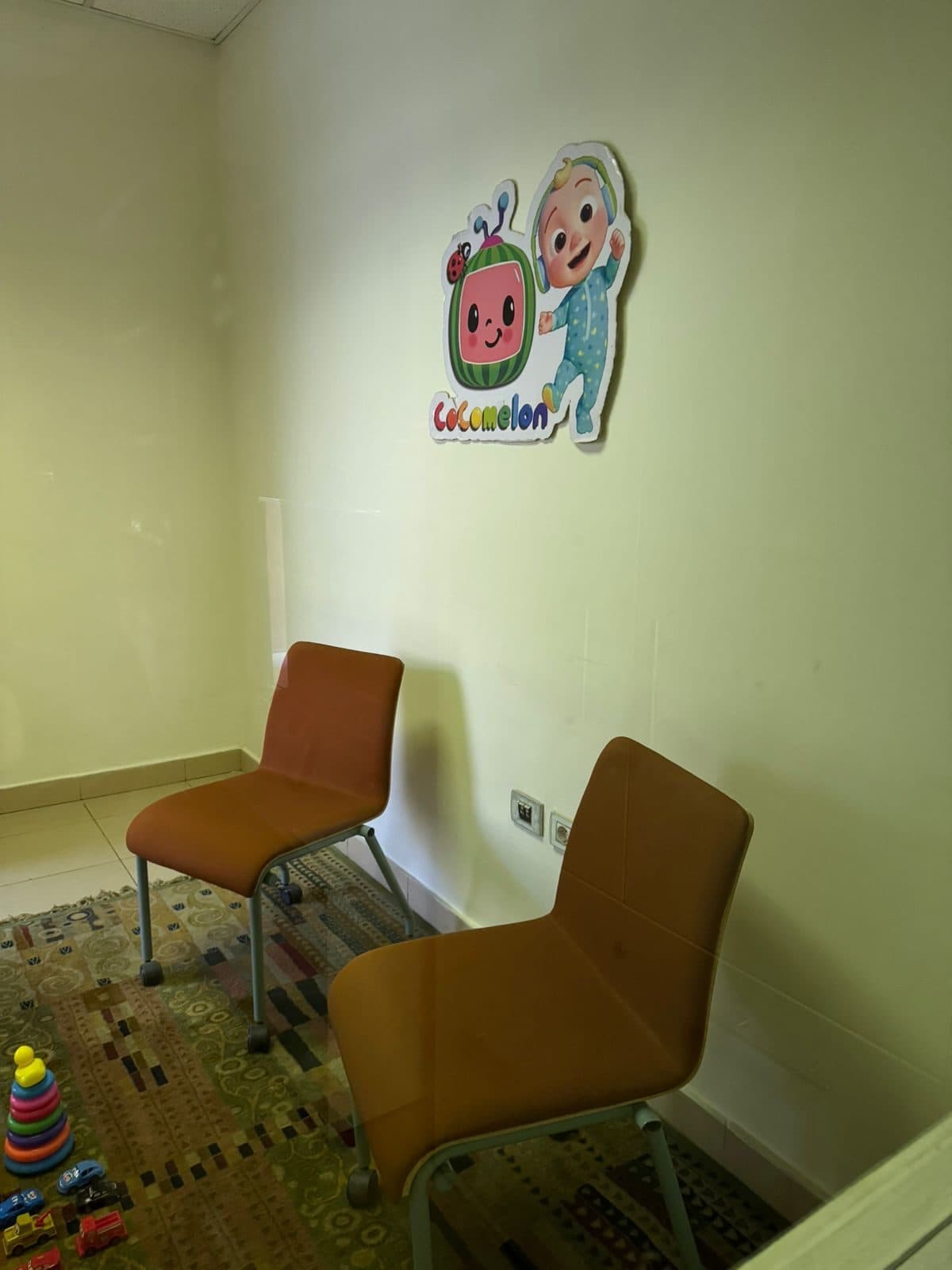
The observation room 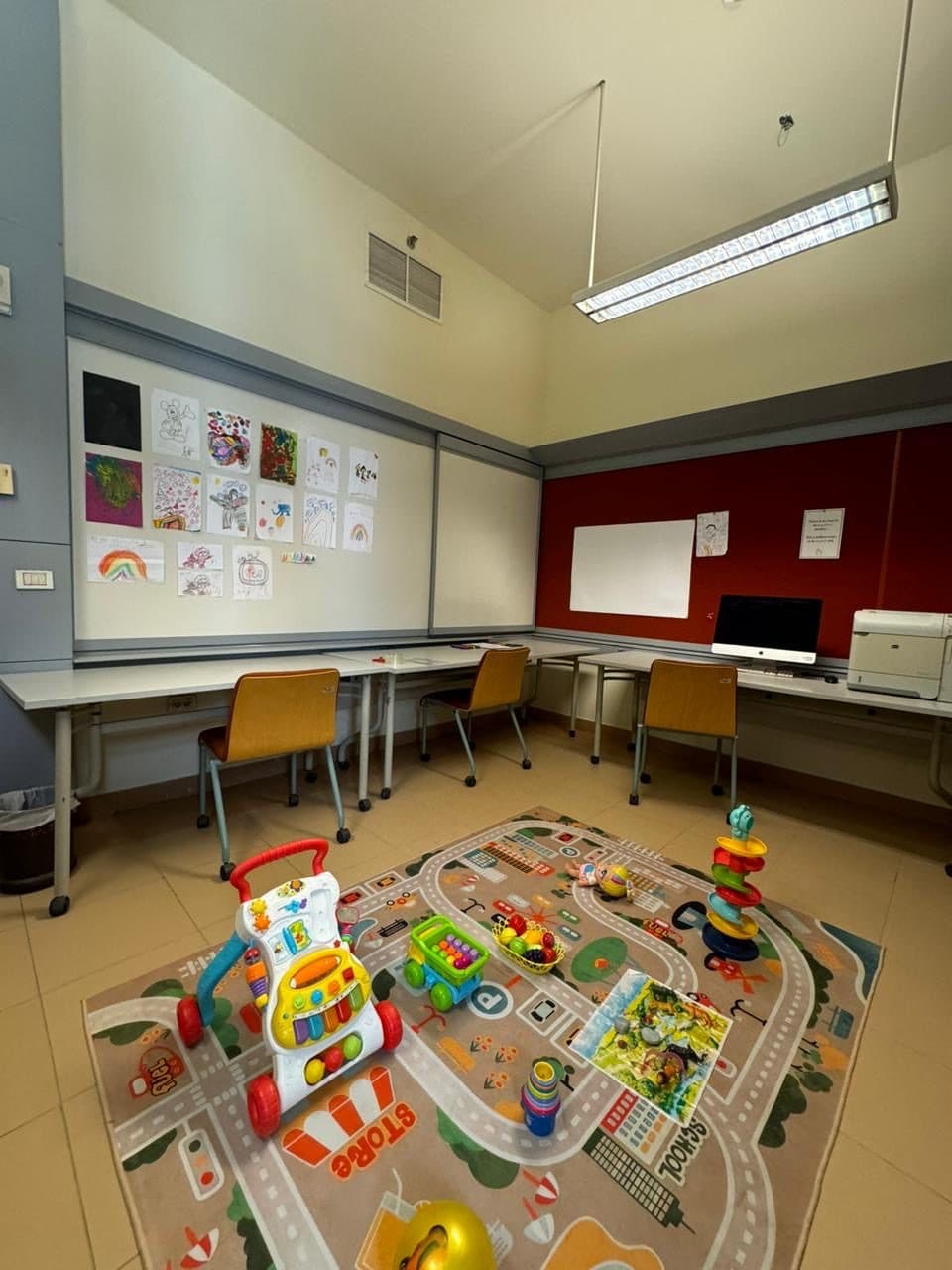
The playroom - The visit starts in the observation room, where you and your child or children take part in a short observational procedure of around 30 minutes.
- You then move to the playroom, where you fill out a self-report questionnaire on the computer while your child has space to play. Your child stays with you, and one or two research assistants can play with them if you would like.
- Once you have completed the questionnaire, you receive a small thank-you gift, and a research assistant walks you back to the gate.
What mothers said
I am interested to watch the webinar and know more about how I can help my daughter in the future and be a better mom for her. The whole experience was different and I really enjoyed it. Thank you so much!
Mothers always feel they’re not doing enough for their babies. So, having research that is aware of the pressure on the mothers and their feelings makes me so happy. I really enjoyed this experience.
It was a very nice experience. All of the team were very kind and helpful. I am so glad that I have participated in this research.
I like the study topic! The venue and toys are suitable for the child. Everyone was very nice to me and my daughter and she enjoyed and did not suffer any distress. Thank you!
Thank you so much for your warm greeting and hospitality. Everything was explained in detail before the session started. My daughter had a great time playing with different toys in a cozy, safe and comfortable place. She was under my supervision at all times and she didn’t feel uncomfortable at any time of the session.
It was a really good experience for me & my child. The study is so interesting for me & I’m glad that such studies are being held in Egypt.
The place is so kids friendly and most importantly everyone was so friendly & welcoming to both me & my baby. I’m so happy I was a part of this experiment.
It was a very different but comfortable experience. The team is so friendly and the instructions were very clear. I did not feel that anything was confusing.
I discovered things about my child and myself as I was interested to see his reaction to different situations in the lab. It was a very nice experience.
I really enjoyed visiting the Attachment Lab and being part of the twins research. The team were extremely friendly and hospitable and made us feel welcome.
FAQs
Common questions about taking part in a study at the lab. Tap a question to see the answer.
When does the observation take place?
Observation timings will be chosen once someone from the research team calls you. In this phone call, you will decide on a time that works for you, your child or children, and the research team at the Attachment Lab.
How much time does participating in a study take?
Timing will vary from one study to another. However, most observational studies take about an hour on campus. During this hour, you can expect to spend around 30 minutes in the observation room, and the other 30 minutes in the playroom. If you have two children, this time will likely be doubled.
I have more than one child. Is it okay to bring everyone?
We have a playroom with a research assistant who can play with the child for short periods of time. While this can sometimes be arranged (based on the child’s age and other factors), if you plan on bringing more than one child, please make sure that you have communicated that with the research team before coming.
Is there free parking?
Yes, we have arranged a parking spot for research participants on campus. Someone from the research team will give you more information on where to park before your visit.
Will I be with my child the entire time?
While you will be able to see your child at all times, most of the observational studies at the Attachment Lab require that you step out of the room for a few minutes. While this happens, you will be able to see your child through a one-way mirror in the neighbouring room.
Do I or my child receive anything for participating?
Yes, for all observational studies, there are benefits that you will get for participating. These benefits vary by study. Please consult the flyer for your study for more information on the benefits you may be eligible to receive.
Will I find out the results of my child’s performance?
At the Attachment Lab, we do not aim to assess performance or any similar skills. Instead, most studies focus on the parent-child dynamic. Within this dynamic, there are no ‘right’ or ‘wrong’ behaviours that you or your child can do. Each parent-child dynamic is different and unique in its own way, and our studies do not aim to ‘assess’ this dynamic, but rather, they aim to understand it.